How to read a credit card's pricing and terms (the Schumer box)
Every U.S. card application must show a standard table of rates and fees, often called the Schumer box. What each row means and what to check first.

Every U.S. credit card application has to include a standard table of rates and fees, widely known as the Schumer box. It’s usually linked as “Pricing & Terms” or “Rates and Fees” next to the Apply button. Federal rules (Regulation Z) set what goes in it and how it looks, so you can compare any two cards row by row. Read four rows first: the purchase APR, the annual fee, the grace period and the foreign transaction fee. Those decide what most people actually pay.
Where do you find the Schumer box?
On the card’s application page, usually behind a link called “Pricing & Terms”, “Rates & Fees” or “Terms and Conditions”. Regulation Z requires the table to be prominently placed on or with the application and, online, close to it.
For a card you already have, the same terms are in your cardmember agreement. The CFPB keeps a public credit card agreement database with general terms, pricing and fees from hundreds of issuers, and your issuer must give you your own agreement if you ask.
What’s in the table, row by row
Regulation Z lists what the table must include. Rows that don’t apply to a card can be left out, except the grace period row, which must always appear.
Interest rates
| Row | What it tells you |
|---|---|
| APR for Purchases | The yearly interest rate on purchases you don’t pay off. If it varies, the table says so and names the index it follows, such as the prime rate. Often shown as a range; your rate depends on your credit. |
| Intro APR (if any) | A lower promotional rate and how long it lasts. Shown with the rate that applies after it ends. |
| APR for Balance Transfers | The rate on debt moved from another card. |
| APR for Cash Advances | The rate on cash withdrawals and cash-like transactions. |
| Penalty APR and When It Applies | A higher rate the issuer can charge after events such as a late payment, and how long it can last. |
| How to Avoid Paying Interest on Purchases (or “Paying Interest”) | The grace period. It says how long you have to pay in full before interest starts, or that there’s no grace period. |
| Minimum Interest Charge | The smallest interest charge you’ll see in a month you owe interest, if the card has one. |
The purchase APR has to be printed in at least 16-point type, and key rates and fees must be in bold, so they’re the numbers that jump out.
Fees
| Row | What it tells you |
|---|---|
| Annual Fee | The yearly cost of having the card. |
| Balance Transfer fee | Usually a percentage of the amount or a minimum dollar amount, whichever is greater. |
| Cash Advance fee | Same structure, charged on cash withdrawals. |
| Foreign Transaction fee | A percentage of each purchase made in a foreign currency or processed abroad. |
| Late Payment fee | The charge if your payment arrives after the due date. |
| Returned Payment fee | The charge if your payment bounces. |
Below the table you’ll find how the issuer calculates your balance (for example, “average daily balance, including new purchases”) and, if there’s an intro rate, the circumstances in which you can lose it.
What to check first
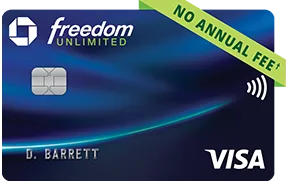
- Annual fee. For example, the Chase Sapphire Preferred® Card charges $95 and the Chase Freedom Unlimited® Credit Card charges $0. If there’s a fee, our annual fee calculator shows whether your spending covers it.
- Grace period. If you pay in full every month, this row matters more than the APR. Our guide to the grace period explains how it works and how you lose it.
- Purchase APR. If you might carry a balance, this is your cost of borrowing. Our explainer on what APR is shows how it turns into dollars.
- Foreign transaction fee. Sapphire Preferred charges none; Freedom Unlimited charges 3% of each transaction in U.S. dollars. If you travel or shop on foreign sites, see our guide to foreign transaction fees.
If you’re comparing cards for a balance transfer, add the intro APR, its length, the balance transfer fee and the APR after the intro. Federal law requires an intro rate to last at least six months unless you’re more than 60 days late, according to the CFPB. Our guide to balance transfer cards runs the math.
What the table doesn’t tell you
The Schumer box covers costs, not rewards. It won’t show:
- Earning rates and welcome offers. Those are on the product page and in the rewards terms.
- Benefits and credits, such as travel insurance or statement credits, and the conditions attached to them.
- Your exact APR. If the table shows a range, you learn your rate only after approval.
- How the issuer applies payments, closes accounts or settles disputes. Those are in the full cardmember agreement.
So read both: the table for what the card costs, the product page for what it gives back. For how rewards compare, see cash back vs points vs miles.
Words that trip people up
- Variable APR: the rate moves with an index, usually the prime rate. If the prime rate goes up, so does your APR.
- “Up to” and ranges: the issuer decides where you land based on your credit.
- Penalty APR: triggered by events the table names. It can apply to new transactions; the table says when.
- Account opening: the date many deadlines count from, including intro periods and transfer windows.
If your rate or a fee on your statement doesn’t match these terms, you may be able to dispute it as a billing error; see how to dispute a credit card charge.
Cards in this article

Sources
- Regulation Z, 12 CFR 1026.60: Credit and charge card applications and solicitations
- CFPB: Know Before You Owe: Credit cards
- CFPB: Credit card agreement database
- CFPB: What is a grace period for a credit card?
- CFPB: How long can I keep a low rate on a balance transfer or other introductory rate?
- Chase Sapphire Preferred pricing and terms
- Chase Freedom Unlimited pricing and terms



